Latest Posts

Learning to plow…

I think of plowing as the quintessential activity of a real farm.  In fact, I hestitate to call my place a real farm because of the lack of said, plowing.  I’m fond of the ‘lasagna’ method of growing crops…layering compost and straw and cardboard.  I’ve run a rototiller a few times, but its just not my thing.  So recently, when I had the opportunity to learn to plow….for real…I hopped on board, quite literally.

DSCI0067

Some of you may know that I have agreed to sell Peanut to a nice couple in Vermont who plan to farm with him.  He is on trial with them as I write this….staying at Ted’s place, where they are learning the ins and outs of driving a work horse.  I brought Peanut up last week.  Ted and I had hatched a plan (well, mostly I did) that we should put Peanut and Clayton together to plow at the GMDHA fall meeting.  Ted wanted Peanut there a few days early to practice.

So Thursday morning, I help Ted harness up the horses and we hitch them to this antique plow…I believe a John Deere ‘Syracuse’….I could be wrong, but it was old and looked like a death trap.  Nothing like sitting on a rickety seat sprung over a metal cage and huge plow blades beneath you.  No seat belt and no brakes…it looked horrifying!  I was happy to watch.  Plowing with horses is interesting to watch.  The more experienced horse generally walks ‘in the furrow’, while the other simply helps pull the plow along.  The plow edge slices into the earth and folds it over on itself, kind of like you are carving a nice piece of meat.  The look of a freshly plowed plot of land is somehow appealing, in its tidiness and uniform rows.  Ted certainly made it look easy….

Then he hopped off and handed me the reins.  I think I kind of gave him a glazed over expression as I said, ‘sure’.

Getting the boys lined up in the furrow proved easy enough, but then you have to pull the lever up and over to engage the plow.  Here’s where it gets personal.  The act of moving this lever actually lifts you up as the plow engages.  Well, I belive I outwiegh Ted by 50 lbs at least and to say I am half as strong would be generous, so lifting that lever was not easy.  I needed alot of help in the beginning.

DSCI0070

I did learn very quickly, however, that if you asked the horses to ‘step up’ a step or so, while you tried to engage the plow, they actually helped pull the lever over and into position.  Voila, ready to go.  Next you have to keep the furrow horse in the furrow (on the right) and the plow over to the left.  Ted said the furrow wheel should be ideally 2 inches inside the furrow edge.  I took that very seriously as I do all specific instruction.  In fact this is what began to fascinate me about plowing.  The exactness and the linearness of it endeared me to the process…I was hooked!

Two days later we were plowing at the fall meeting.  Add some wet soil from days of rain and abit of a hill and it was a whole new ballgame!  But the principles remained the same and before long I was plowing on my own and feeling empowered!
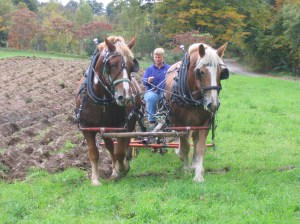
IMG_5607

Plowing is indeed an addicting habit.  I am now triing to figureout how I can buy a plow…
Fall at Resting Heart Farm…a photo essay

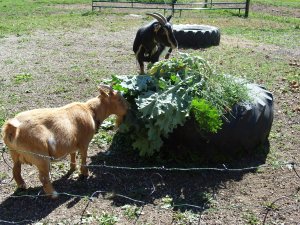
Alice and Betty enjoying leftovers from the garden....lettuce, arugala and kale.  Kale is their favorite...good thing as its not mine!

Alice and Betty enjoying leftovers from the garden....lettuce, arugala and kale. Kale is their favorite...good thing as its not mine!

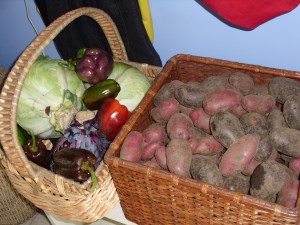
Roots ready for roasting...

Roots ready for roasting…
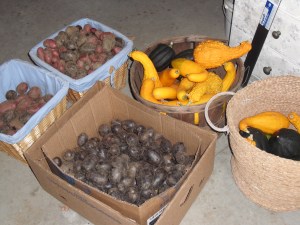
Harvest 2009

Harvest 2009

more harvest 2009

more harvest 2009

New additions to the farm this summer....Daisy and Doris...muscovy ducklings

New additions to the farm this summer....Daisy and Doris...muscovy ducklings

farm truck....82 chevy...only 32K miles on it

farm truck....82 chevy...only 32K miles on it

New landscaping this year.  Kevin Roberts built us a wall and some steps...all the stones came from our property.  Gotta love living in the granite state!

New landscaping this year. Kevin Roberts built us a wall and some steps...all the stones came from our property. Gotta love living in the granite state!

This is the old pig pen, nicely turned over soil.  Seeded and new beds built.  I fill them with nearly finished compost.  I'll let them get soaked this week then cover them with  mulch hay.  Ready for early crops next spring.

This is the old pig pen, nicely turned over soil. Seeded and new beds built. I fill them with nearly finished compost. I'll let them get soaked this week then cover them with mulch hay. Ready for early crops next spring.

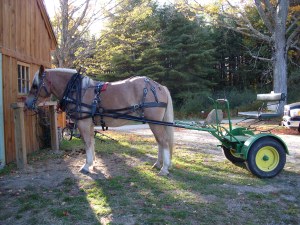
Peanut and his John Deere

Peanut and his John Deere

Reconnecting with Manny

The past year has been so full of youngsters, rescues, rehabs and the rebuilding of my practice, I’ve had little time to spend with my best horse Manny.  He’s 15 this year and we’ve been together for over 10 years now.  He’s the type of horse now that remains reliable even after a lengthy period of time off.  He wasn’t always like that and we’ve had our fair share of differing opinions, outright arguments and plenty of wrecks….mostly the type where I am on the ground with him glaring at me from above.  Being a very alpha horse, he knows how to make his point.  I’ve learned from him over the years how to be a confident leader and a sympathetic rider, more partner than master and we have come to appreciate each other immensely over the second half of the past decade.  I think of him more as Mensa than horse.  We have a magnet between us…when I see him at the gate, I have to walk over and rub his muzzle.  When I am working in the pasture, he is always at my shoulder.  What was once a loud, rowdy argument, is now a peaceful connected agreement.

100_1831Its the type of relationship you don’t see too much anymore….the product of hardwork and mutual respect…solidified through fire.  I had many friends try to convince me to get rid of Manny in the early years, afraid I was going to be hurt seriously.  But I’m pretty stubborn and so was Manny…we simply had to negotiate the rules of our partnership on our own terms and in our own time.  The process wasn’t always pretty, but I am a better person today and he a better horse because of that rocky start together.DSCF0323
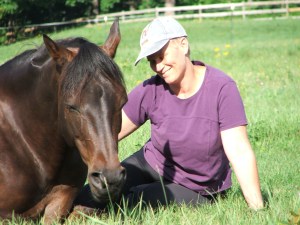
Every year Manny and I go camping down near the Cape at Myles Standish State forest with friends.  We’ve been going for 6 or 7 years now.  It is generally my favorite vacation of the year.   This year was even more lovely as Manny and I got to spend some quality time together for a change.  The weather was perfect.  Our rides were spectacular!  We did some swimming, explored new trails and galloped through Cutter Field a dozen or so times…exhilarating!

IMG_2631

Our down time was spent around the campfire, relaxing, reading or just telling stories.  Manny would stand by the fence as close to us as possible and snooze.  He had the softest expression I’ve ever seen, all week long.  He genuinely appear to be happy to have me all to himself.  It was time without the distraction of young horses needing exercise, the sick and injured requiring care or the neverending farm ‘to do’ list.  There was enough quiet to reflect on all the amazing stuff we are now able to do together and all the crazy adventures along the way.  Time spent reconnecting is a beautiful thing for any relationship…be it animal or human.  I recommend it highly!

100_1808

Feedback

Feedback is a really important part of training horses…any animal for that matter.  Being non-verbal for the most part, horses use body language to communicate their mental and emotional state, as well as their physical well being.  Its important as a trainer and as a caretaker to observe this feedback and make adjustments in our agenda to address feedback, when necessary.  Some feedback requires nothing more than acknowledgement, such as a horse wrinkling his lip with pleasure during a good grooming session.  Some feedback requires action, such as a pony pinning its ears during feeding.  In such a case, I might simply insist he share his food with me or request he back away from his supper for a moment for an attitude adjustment. Feedback can be quite complex and the body language difficult to interpret….is it fear, is it dominance, is it confusion? Using punishment or dominance with a horse that is scared or confused will produce unsatisfactory, sometimes disasterous results. Such is the art of living and working with an animal.  To complicate matters more, there are horses that use body language very efficiently and energetically and others who are more stoic, showing little in the way of opinion.  I find the later more challenging, but most horses are somewhere in between.

The most obvious of body language can be sorted out by watching horses ‘talk’ to each other.  We all know what a swishing tail or pinned ears mean, and generally what follows if that feedback is ignored.  Horses often use movement and energy to alert their herd members to percieved danger or to engage in play.  We see these behaviors during training as well and need to interpret their meaning correctly to maintain rapport as well as progress in the training process.

But the type of feedback that I have been thinking about recently relates to physical limitations and rehabilitation.  For instance, Reno, while he has pretty typical body language in regard to manuveuring the herd, showing pleasure and confidence as well as lack of confidence,  he is quite stoic in regard to his physical condition.  Recovering from 2 very serious injuries in the left hind, he really rarely showed evidence of pain or discomfort.  Now that he moves relatively normally, its even harder to percieve what his true limitations are.  One of the reasons I decided to start riding him in stead of driving him during his rehabilitation is that I wanted a different way to access feedback about his physical status.  Sitting on his back I get a better sense of where he is stuck or stiff.  I can sense when one stride is shorter than another and when he braces in the neck or becomes disconnected behind.  Recently I have become aware of a new form of feedback that astonished me.  For months, I’ve concentrated on the injured left hind nearly entirely.  As in any instance when I focus too narrowly,  I risk missing the larger picture.resized_more_biting

I had ridden Reno 3 days that week and he was coming along nicely.  My first bit of feedback was that he preferred to canter on the right lead…..odd, I thought, that lead should be the harder for him, given his injury.  The next bit of feedback went right over my head until this morning.  I noticed last week that my right hip and back were killing me.  In fact, I woke up one morning wondering if I had a kidney infection…it was intense.  Try as I might, I could not think of anything I had done to injure myself.  My back is not perfect, and so I blew it off and took some ibuprofen.  It did indeed improve over several days.

Yesterday, I put a saddle on Reno for a ride after a week off.  My sis-in-law wanted to sit on him in the worst way.  I rode for 10 minutes to get him settled for her and after her brief ride, I did some light work with him before heading back to the barn.  Well, several hours later, the right hip pain was back, along with a stabbing pain in the upper back….just like last week.  HELLO, a lightbulb went on, when I realized I was mirroring Reno’s pain.  Fascinating!  How could I have missed something so obvious…something that makes so much sense.  Reno spent months with his left hind leg off the ground, leaning on his right.  Of course his right hip is stuck and sore. I knew that intellectually, but had no idea how severe it was.  Bingo!  Feedback!

I have read about this type of mirrored pain…generally in the reverse form.  In those cases a horse picks up the pain syndrome of the rider like a mirror and can become lame.  Truly fascinating!  The phenomenom, in a positive way,  explains the ‘oneness’ good riders feel on their mounts and how some rides just seem to flow from within….with barely a cue from the rider.  In the past, I have actually felt relief of back pain from a good balanced ride on a sound and willing mount.  But I digress…back to feedback.

So being the scientist you all know me to be, I will have to ride every horse on the farm this week to be sure its not just me and my bad back.  I will do it, but I suspect I will be fine.  That’s the other piece…intuition.  Anyone successful around horses developes this sixth sense.  You just ‘know’ when you are right.

So now that I have identified this source of feedback, I now need to process how to deal with it and obviously, make it better.  This will likely be the topic for another post.  For now, I have to simply accept these facts as feedback.

Roosters

I’ve known a few roosters in my day. Some are calm and gentile with the ladies, others are just outright ‘peckers’ and are abusive. The dominant, out going rooster has its benefits in regard to predator control, but they can get out of hand with kids and visitors.

We had such rooster in our midst. Fooled by his youth and good looks, we tolerated his bizarre aggressive behavior UNTIL he stabbed my poor mother in the leg. Being on coumadin (a blood thinner), this was unacceptable. 2 days ago he attacked my two nieces and a nephew…scaring the crap out of them. Mom and I both agreed a rooster stew was on the menu!

My bother, Bear and his family were here. He had brought his rifle, as I was wanting a certain fox eliminated. Once our new objective was clarified, the shooting began. I shooed the rooster out into the open and the firing squad began. Near misses all afternoon. I believe Bear was suffering from severe embarrassment…must be something wrong with the scope. He skimmed the bird several times but did not kill it. The kids hid under the lawn chairs…

We gave up the chase in time for the neighbors ‘soiree’ and had a few drinks in very nice company. On the way home, I suggested we visit the now sleeping rooster and end its aggressive ways.

Bear, eager for a confrontation, crept up on the sleeping beast and attempted to throttle him. He then let him go, expecting him to flop to the ground in the throws of death, and was surprised to find the bird dancing like a youngster…now ready to play! The bird had some wiley survival skills! Bear trapped and captured the bird once more (with me cheering him on), but he couldn’t get a good ‘break’ in the neck. Ever resourceful, I ran to the house and picked out a knife. Upon my return, we tried to remove the head, only to break the knife. Frustrated, but drunk, I ran back to the garage and retrieved the limb lopers. At that point Bear was convinced her had broken the poor bastards neck at last. We severed the head from the body to be sure…using the lopers! We tied the bird up by the feet..as a warning to all other birds and left it overnight.

Plucked and soaked…we have a nice soup stock tonight!

Cilantro Pesto

I love to grow herbs!  Basil and Cilantro are my favorites, although I find room for bay leaves, dill and some oregano.  I make alot of pesto,  in icecube trays and store it frozen.  But storage is an issue for other herbs.  My beloved cilantro bolts to seed by mid July…hardly available for my fall salsa projects.  So I have searched high and low for a storage solution.  I came across this recipe recently and tried it……wonderful!  I froze it in 2 oz rubbermaid containers for use later in the season.

Cilantro Pesto

2 cups, packed, cilantro, chopped, large stems removed

1/2 cup blanched almonds

1/4 cup chopped red onion

1/2 tspn chopped and seeded serrano chile pepper

1/2 tspn kosher salt

1/4 cup olive oil

Method:  In a food processor, pulse cilantro, almonds, onion, chile, and salt until well blended.  With processor running drizzle olive oil in a steady stream.   Add more oil as needed for your use.

Freeze in small containers or ice cube trays and store in freezer.

Riding Reno…the first 3 rides

DSCN1169

Reno’s training is primarily as a driving horse.  I believe he has been ridden sporadically by some kids, but no formal training.  He’s got a pretty cooperative personality, so I didn’t think it would be huge deal to get him going undersaddle.  I also felt I could help him rebuild his topline and atrophied musculature in his haunches putting him through some low level dressage maneuvers such as ‘shoulder in’.

Our first ride was mainly a ‘meet and greet’ event.  Teaching him to pick me up at the mounting block and stand quietly.  Walk, simple turns, stop, back up.  By the end of the session we were doing some walk-trot transitions as well.  What I learned about him is that his driving experience had set-him up well to understand rudimentary rein cues undersaddle.  I had to reinforce leg and seat cues with the verbal cues he already knew…kiss, whoa, back up, easy, etc….in the beginning, but he very quickly understood what I was asking.  We ended our first ride by taking a leisurely, trail ride back to the barn.  He balked at a gate and at the pigs, but easily moved past these obstacles with alittle squeeze from me.  Above, pictured by the chicken coop.  It was an exceptionally good first ride.

During our second ride, I was pleased to find he had remembered our mounting lesson….he walked over and parked himself next to me on the mounting block.  Some people might take mounting a horse for granted and not spend too much time training for it, but when it comes to mounting an 18 hand horse, you really do want him to stand still and wait for you.  Besides which, a horse that has the tendency to walk off when you are mounting is also likely to move their feet at other times when you don’t want them to.

Anyhow, the riding portion of our second ride concentrated on patterns…cloverleaf and circles…walk and trot with lots of transitions.  Once the patterns were solid, we cantered in both directions.  He had a hard time cantering in a circle and believe it or not his right lead was his favored lead.  With the injured leg being the left hind I would have thought the left lead would be more comfortable.  Hmmm…interesting.  His canter is very smooth and has a rocking horse feel to it…very nice.  Again another leisurely walk back to the barn.

Today was our third ride and my goal today was to introduce ‘shoulder in’, which is a great exercise to build up strength in the haunches and connect the hind end to the front end.  We warmed up in the cloverleaf, walk trot and I really concentrated on keeping him soft in the bridle especially in the turns.  Then we went on the tackle ‘shoulder in’…which I started as a ‘counter shoulder in’ using the fence to block his forward movement.  I wasn’t looking for the finished product, just for him to step over and under his body with the (in this case) outside hind.  It took abit to get the point across, and then we had a few good strides of it.  It was clear that this was hard for him, so we didn’t work at it for too long.  The bugs were atrocious so as soon as he felt confident about what we were doing, we skidaddled out of the arena and went for a bonafide hack…off the farm and into the surrounding fields.  It was lovely to trot through some long stretches of fields then we looped back through the woods toward home.  He was solid as a rock!

At this point it will be a challenge to keep him working at a level that is therapeutic for him without being too taxing, but so far so good…

Spring and Summer with Reno

My last post about Reno was in late March and was full of optimism, as we had finally seemed to overcome his hock injury and were in ‘rehab’ mode.  There are many reasons why I have not updated his progress.  Foremost is a lack of time.  Spring is always a very busy season for me with pasture maintenance, veggie gardening (this year I have extensive plots of potatoes and corn) and this year pigs.  But in all truth, I was waiting to feel optimism again.

Two weeks after my last post regarding Reno and the beginning of what should have been his rehabilitation, he had a set-back.  I found him on 4/7/9, standing alone in shock, hemorrhaging from his previously injured left hind.  He had had a fight with the fence and wrapped the poly wire around the leg, struggled (and eventually tore down a complete length of fencing), lacerating the leg below the hock right down to the canon bone.  My vet confirmed that he had severed the extensor tendon completely.  In addition, she was worried that the flexor tendon might be at risk with a late necrotic event (because the wound was circumferential).  I was devastated and quite frankly, depressed.  Once I got Reno settled in a stall, for what would be 3 weeks of stall rest, I phone his owner, Andre and told him about the accident.  I’m pretty certain Andre never expected Reno to come back to work and simply wanted some sort of life for him.  I simply asked for Reno to be mine, permanently.  For some reason it seemed important at the time, though I have no doubt Andre already thought of Reno as mine, and that enabled me somehow to go forward with more resolve.

Three weeks of stall rest, daily cold hosing and dressing changes later, I turned Reno out with the mini rescues in a smallish flat turnout.  It was progress.  His attitude has been awesome throughout.  Even during the stall rest he managed to be engaged and friendly with my nieces and nephews…who adore him.  I took him out for a short walk once or twice a day, just to keep his muscles from freezing up entirely.100_15852813_1129682968298_1413953157_30343173_5473727_n2813_1129680888246_1413953157_30343169_4024181_nExtensor tendons enable a horse to lift the toe during gait to allow proper landing on the foot on the ground.  Injury to the tendon causes tripping when the toe inadvertently gets flexed on landing, so the toe hits first and buckles.  Its scarey to watch it happen and can be unnerving to the horse, but Reno never got excited about the problem and it happened less and less frequently.  I did alot of reading about extensor tendon injuries and realized that a good 80% of them recover completely…piece of cake…I’ve beat odds way worse than that!!!
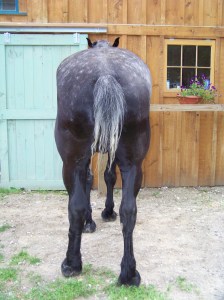
My immediate concern was that we were losing the gains we had made in his hind end development from earlier in the spring.  He was already in such bad shape behind…atrophy on the left, fatigue and spasm on the right.  And anyone who has ever rehabilitated a horse knows that colic and founder are both eminently waiting in the wings for an injured animal.  I worried incessantly, but all I could do was wait.  Three more weeks in  the small turnout and we were still ahead of the curve….I was amazed.  The general time line for tendon injuries is 6 months (or more).  In 6 weeks he was able to rejoin the main herd.  I probably pushed this time line abit.  I’ve always believed that healing happens faster when the injured area is subjected to some amount of stress.  The body has mechanisms in place that accelerate healing when necessary…I was counting on this mechanism to jump start his progress again.

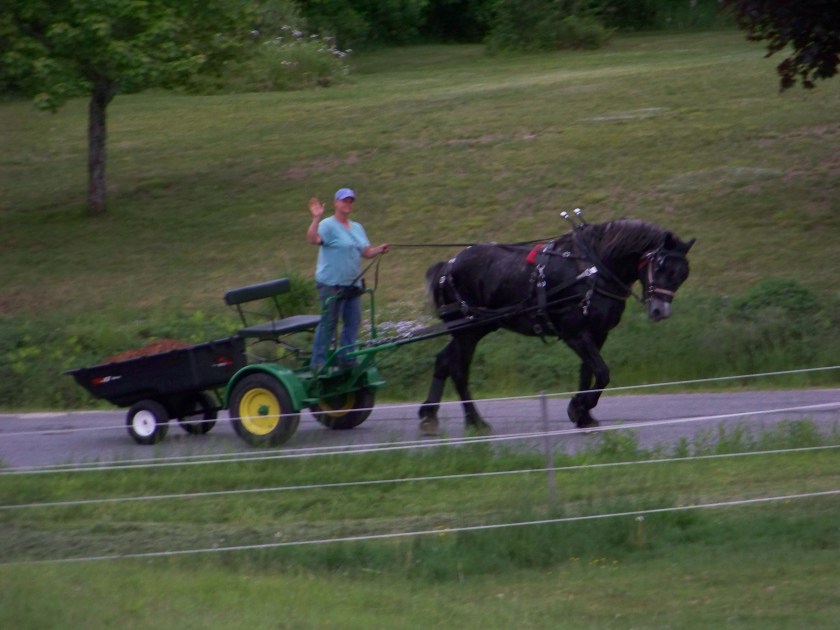
Thankfully, my instincts were good and he did well.   Two months later (to the day), I drove Reno and he pulled a load.  It was a short bit of work, but it seemed like a mountain of accomplishment!100_1707

After this inital success, I drove Reno 2-3 times a week, for short distances, but incorporated hills and lots of stops at neighbors houses.  He was getting stronger and stronger.  His ass was also filling out nicely!100_1767In July, we had a visit to Vermont with Reno’s extended family and he pulled a wagon with Coral, Andre’s lead mare. Reno was awesome, as was Coral and I found my optimism once more.100_1789Since then I have started to ride Reno…but that will be a new post.
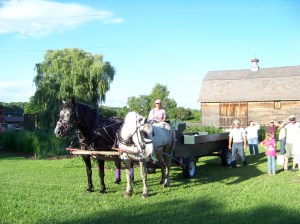
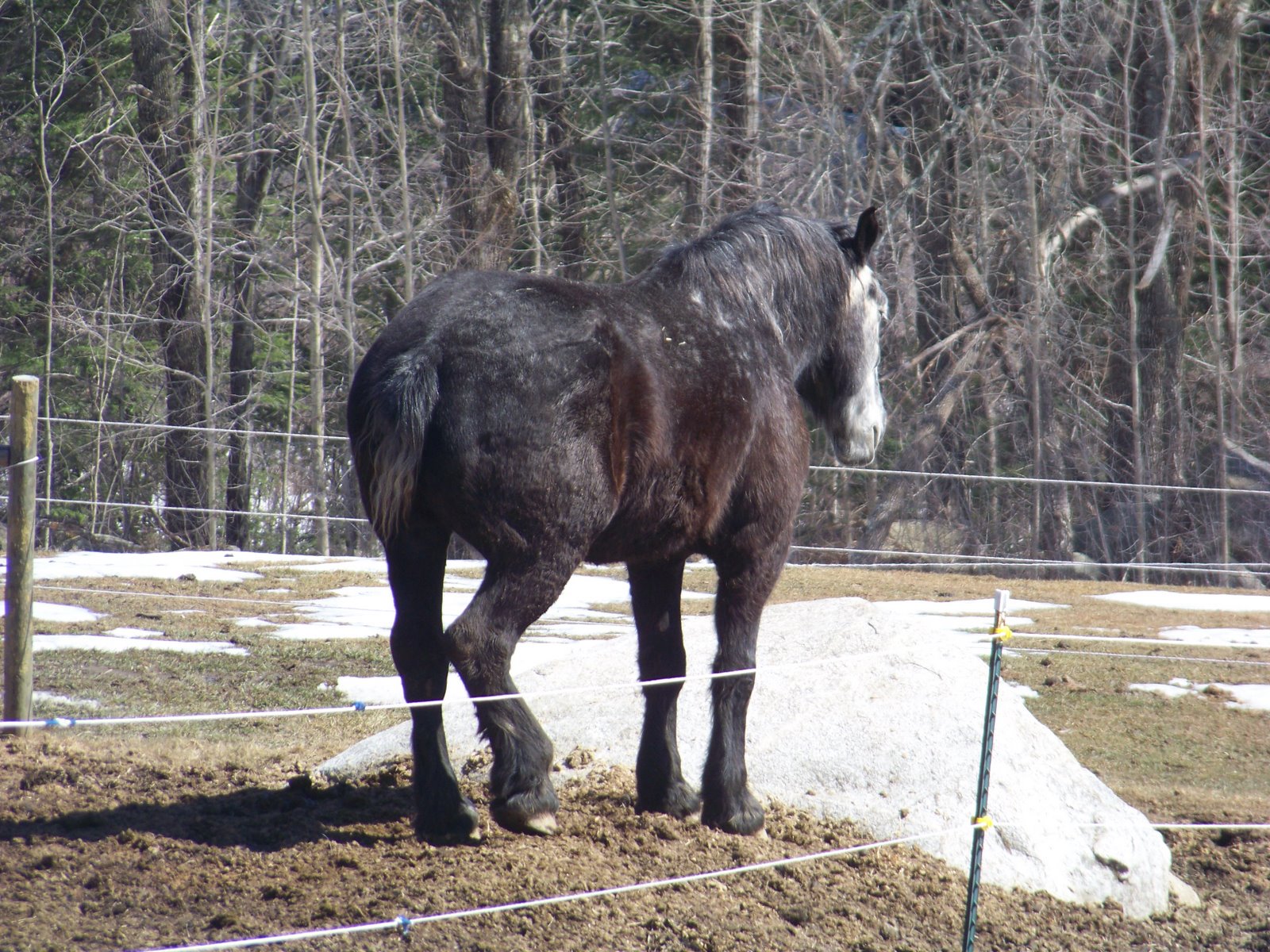
To read more about Reno’s original injury, go here.

Pigs and Horses…

This post was lost in my edit file from April.  Made me smile remembering that day.  The horses and pigs are surprisingly tolerant, even curious towards each other nowadays.
April 2009
I brought home my first pair of piglets last night, Spam and Hamlet. I decided to put them in the barn because of the weather (freezing rain here) to settle in for a few days. While I got the stall across the aisle from the horses stalls ready for them, I left them squealing in the back of my truck.
The horses, having never seen a pig, decided to vacate the premises and ran off to the far end of their winter paddock. Ever curious, they carefully crept back to the barn area just in time for me to haul the first squealing pig to its new home in the barn…pandamonium set in and off they went again to the far end, nearing tripping over each other in their hasty getaway. Well, I waited for them to creep back close (they were afterall hungry and the hay is near the barn) because I am evil and enjoy the spectacle, before hauling the second pig out and bringing it into the barn.
I proceeded with my remaining barn chores and it was pretty evident that the horses would not be coming into the barn under any circumstances despite the weather and insisted that I leave their hay outside. I tried to demonstrate the dimunitive nature of the pigs by picking one up to show the horses, only to finally convince them that these menacing creatures could fly!
I settled for putting some music on to drown out the piglets constant snorting and this did seem to settle the horses down abit, but they still showed no interest in coming inside.
This morning, I was greeted by five horses who appeared ‘hung over’, like college kids that stayed out too late partying on a school night. My thin skinned TB was particularly surley grabbing mouthfuls of hay from the bale I was hauling out for them. Nose pinched, he looked at me accusingly….’I’m wet, I’m cold, where have you been?’
Meanwhile, the piglets were curled up in a corner fast asleep. I left the barn with Bob Marley inappropriately singing the words “Is this love, is this love, is this love that I’m feelin’…”

Reno Update

Reno has been turned out with my gelding herd for 2 weeks now. My vet and I both agree that he has shown enough improvement that he now has to USE the leg to get function back. Still on oral antibiotics, we’ve had no set-backs despite alot of playfulness in the mud with the other horses.

Pictured here actually ‘resting’ on the bad leg…a very good sign.

He finishes his antibiotics (a full 6 weeks) in a few days. I’ll be watching him carefully for any relapse at that point. So far, so good.